



How do public health institutions monitor the physical activity levels of populations?
Population based physical activity data is captured with surveys. The National Health and Nutrition Examination Survey (NHANES) is the principal source of physical activity surveillance in the U. S (CDC, 2018). The International Physical Activity Questionnaire (IPAQ), and the World Health Organization developed Global Physical Activity Questionnaire (GPAQ) are examples of standardized physical activity surveys that are used for international comparisons. These surveys provide important metrics to illustrate if environmental and policy strategies such as street and community design have been effective to support physical activity.
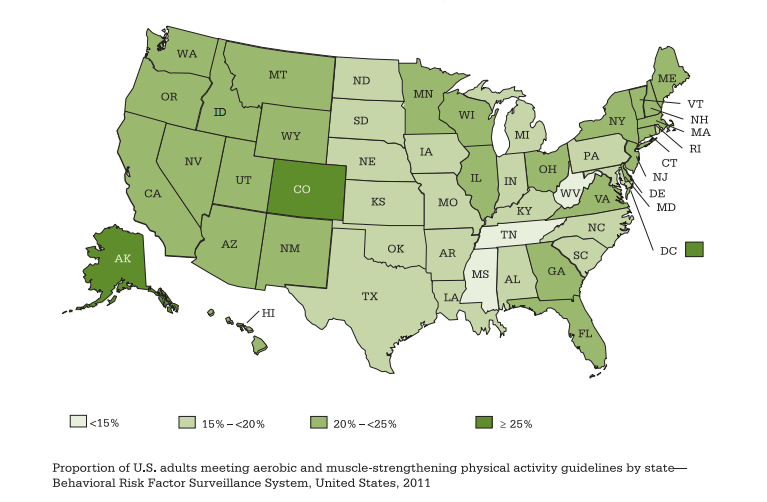
CDC, 2014
Given the limitations that self-reported measures create in terms of reliability and validity, the advent of body worn physical activity monitors (PAMs) now provides opportunity for additional objective measurements of physical activity levels. The NHANES surveys added PAMs in 2003 initially with a waist worn step counter however now a less cumbersome wrist worn accelerometer is used (CDC, 2007) The technology of PAMs have progressed over time and the following is a breakdown of the different levels of technology within the activity monitors available today:

Activity tracking has transitioned from research into consumer devices such as the popular Fitbit and Apple watch. These devices offer convenient unobtrusive measurements of various health monitors such as heart rate, sleep cycles, and activity levels for health conscious individuals. As wearable devices become more sophisticated and multifunctional with various service options of managing personalized health data, the issue of personal data security becomes a significant concern.
The general belief is that our health information is private. Fortunately there are existing regulations to provide some protection of personal health data through the Health Insurance Portability and Accountability Act of 1996 (HIPPA). This federal law provides individuals authority over who may be view or use our health (HHS, 2017).
Who is required to follow HIPPA regulations?
- Health Plans
- Most Health Care Providers
- Health Care Clearinghouses
- Business associates of the above entities such as:
- lawers
- accountants
- IT specialists
- companies that store or destroy medical records (HHS, 2017)
Who is not required to follow HIPPA regulations?
- Life insurance companies
- Employers
- Workers compensation carriers
- Most schools and school districts
- Many state agencies like child protective service agencies
- Most law enforcement agencies
- Many municipal offices (HHS, 2017)
There are obvious gaps in which entities are obligated to follow personal health data protection. Consumers of health and fitness tracking devices and applications need to be aware that while it may seem private using personal phones or controlled social media platforms, the data that is collected and transmitted provides valuable medical data that is “highly open to third parties including the device developers” (Lupton, 2016). Both government and industry will need to navigate through the advancing information and communications technologies, maintaining the promising benefits of such innovation while mitigating the ethical risks and concerns of data privacy.
UNCTAD, 2016
References
Center for Disease Control and Prevention. (2018). National center for health statistics: National health and nutrition examination survey. Retrieved from https://www-cdc-gov.ezproxy1.lib.asu.edu/nchs/nhanes/index.htm
Center for Disease Control and Prevention. (2007). National health and nutrition examination survey: 2003-2004 data documentation, codebook, and frequencies. Retrieved from https://wwwn-cdc-gov.ezproxy1.lib.asu.edu/nchs/nhanes/2003-2004/PAXRAW_C.htm
Center for Disease Control and Prevention. (2014). 2014 state indicator report on physical activity. Retrieved from https://www-cdc-gov.ezproxy1.lib.asu.edu/physicalactivity/downloads/pa_state_indicator_report_2014.pdf
Lupton, D. (2016). The quantified self : A sociology of self-tracking Cambridge, UK : Polity.
National Institute of Health. (2018). Epidemiology and genomics research program: International physical activity questionnaire (long, self-administered). Retrieved from https://epi.grants.cancer.gov/paq/q026.html
The Irish Times. (2017). Fitness trackers run into resistance over data securtiy concerns. Retrieved from https://www.irishtimes.com/business/technology/fitness-trackers-run-into-resistance-over-data-security-concerns-1.3119483
United Nations Conference on Trade and Development. (2016). Data protection and privacy. Retrieved from https://www.youtube.com/watch?v=6vNxslcf9AE
World Health Organization. (2018). Global physical activity surveillance. Retrieved from http://www.who.int.ezproxy1.lib.asu.edu/ncds/surveillance/steps/GPAQ/en/

 One Health
Surveys are a great way to collect information. It is shocking to think that less than 1/4th of adults in Arizona are meeting the aerobic and muscle-strengthening physical activity guidelines. Limited information is obtained by The National Health and Nutrition Examination Survey (NHANES) because of random sampling. The NHANES data has been used for many important policy changes including removing lead from gasoline and updating growth charts (Center for Disease Control and Prevention [CDC], 2016).
The technology used to monitor fitness and activity today is incredible! The organization that I work for provided employees with free Apple watches if they met a certain daily step count with their watch. Access to information about our exercise habits, average heart rate, and personalized health data should be of significant concern for users of activity tracking devices. I had not considered that The Health Insurance Portability and Accountability Act of 1996 (HIPAA) does not cover companies like Apple or Fitbit because these devices are used for non-medical purposes. These types of entities do not fall under the jurisdiction of HIPPA. This means that health insurance providers and advertisers can easily access this information. This could potentially result in a change in health insurance coverage for individuals based on this data. Most consumers are probably unaware of this risk.
Reference
Center for Disease Control and Prevention. (2016). National health and nutrition examination survey. Retrieved from: https://www.cdc.gov/nchs/nhanes/hlthprofess.htm
LikeLiked by 1 person
Hi Deb!
I had not put much thought into how physical activity tracking could be used by others. For the most part I think that, like most apps, it has good intentions but there are some serious privacy risks in our high tech and data driven environment. The first example that pops into my head is the obvious double edged sword, someone is always tracking where you are. When you consider how closely we are followed by Google, it’s almost creepy. Most people don’t think about this, I know I didn’t until I saw it on the news and it really made me uneasy. Some total stranger knows where you are at almost all times. This information could potentially be accessed with our Smartwatch devices as well.
Secondly, it makes you wonder how this information could affect your actual health care in the future, if this information is accessible to your employers, insurance companies or health care provider. There are potential benefits (individualized care) but the cons (information sharing, increased costs) could be detrimental to people. There are ways to disable some of the information sharing, on today’s physical fitness apps but most people are probably not aware of this or consider how easily their information can be accessed (medium.com, 2018).
Reference
Talking Tech: Health Apps That Are Always Recording You [website] January 2018. Retrieved from https://medium.com/@OpenSports/talking-tech-health-apps-that-are-always-recording-you-542dea71e838
LikeLike
wow!! 89Built Environments and Healthcare Spending
LikeLike