


While there are several public-sector institutions that influence urban planning, which supports walking and biking, there are several thriving efforts among the private sector as well. One notable advocacy endeavor comes from the Blue Zones Project.
The term “Blue Zones” comes up often in discussions of longevity and was coined by Dan Buettner during his collaborative research with the National Geographic. Buettner discovered five places in the world where people live the longest and healthiest designated these communities “Blue Zones”:

Buettner and his team of researchers examined these places of longest-lived communities and proceeded to not only share the findings but also develop an actionable advocacy through the Blue Zone Project to transform other communities into equally thriving places to live. Buettner shared his discoveries in his 2009 Ted Talk: How to live to be 100+. The presentation has over 3 million views.

Dan Beuttner How to live to be 100
The Blue Zone Project highlights the importance of having a walkable community where people are able to move naturally and emphasizes that supporting this type of activity rather than intentional movement such as exercise is a more effective approach to improve longevity and functionality at the population level. An important case study in the efforts of the Blue Zone Project is the city of Albert Lea, Minnesota. In 2009, the advocacy group made significant community design improvements which was initiated by a “walking audit” identifying ways to create more active and healthy living environments. Improvements in the Albert Lea: Operation Transformation that were implemented included:
- A Bike and Pedestrian Master Plan
- Bump outs to ensure safe pedestrian crossings and wider sidewalks that provided space for outdoor dining
- A five-mile route that was added around a lake within the city
- A connection from the lake route to neighborhoods, parks, downtown and past the local hospital
- Stop signs were replaced with traffic lights
- A complete park renovation with amphitheater for community gathering
The impact of the Albert Lea community design improvements included a 38% average increase in biking and walking throughout the community and a 68% increase in pedestrian traffic in the downtown area. Such results are highlights of the active transport promotion aspect of the advocacy work from this group which in its entirety incorporates a holistic approach involving attention to healthier workplaces, health food options, and tobacco cessation initiatives.
Another private sector advocate is the Congress for the New Urbanism (CNU). The concept of New Urbanism was developed in the early 1990’s by a collective group of urban designers, architects, planners, developers, and engineers who were unified in the belief that the built environment has a large influence on the opportunity for happy and prosperous lives (CNU, 2018). These values and principles were formally articulated in the Charter of the New Urbanism in 1996.
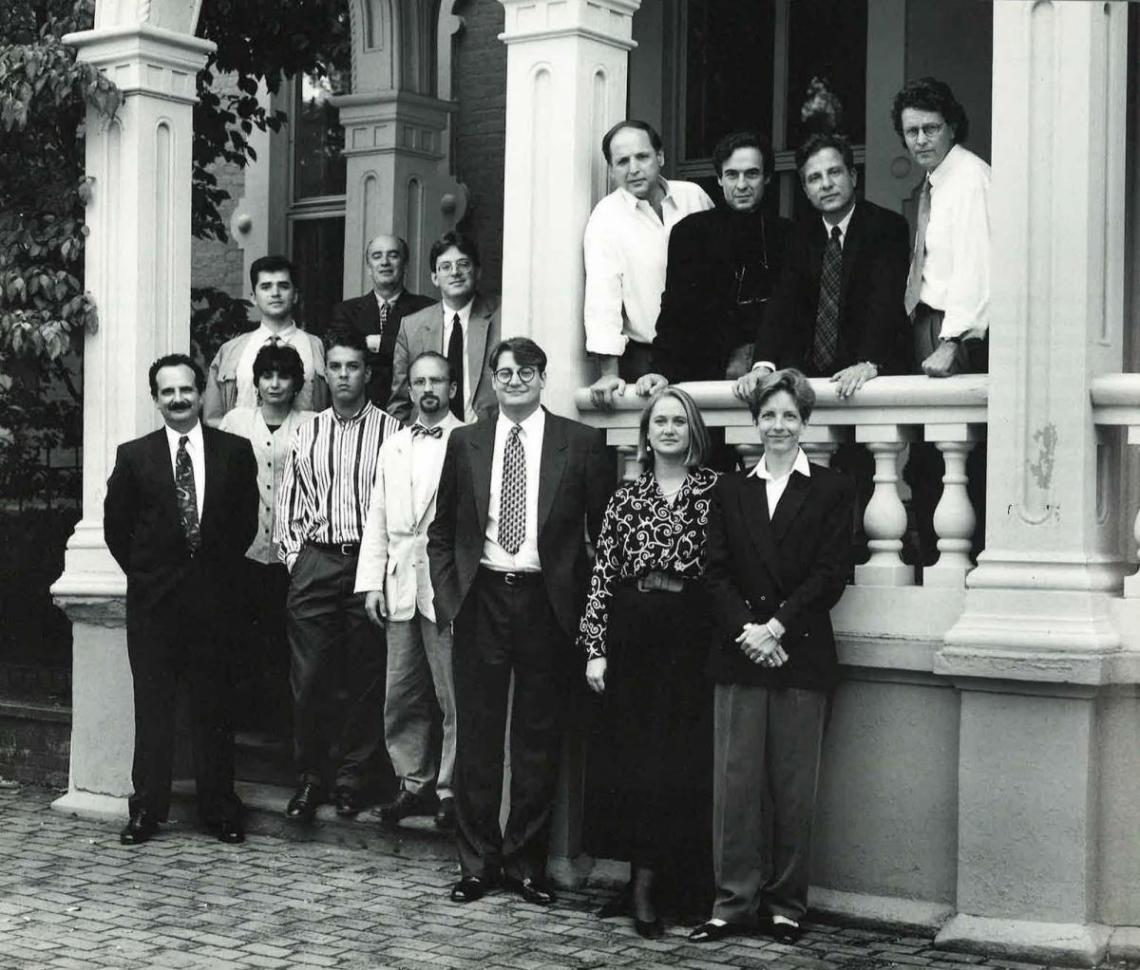
New Urbanist at the first Congress for the New Urbanism, Alexandria, Virginia 1993
“The design of streets, buildings, infrastructure, and public spaces strongly impacts the health of communities and their residents. Research has shown that living in compact, walkable neighborhoods improves health by encouraging more physical activity, while poorly designed communities can exacerbate rates of obesity and chronic disease”
Congress for the New Urbanism, 2018
A substantial contribution from CNU to promote active transport is the concept of Transit Oriented Development (TOD) which was conceived by CNU cofounder Peter Calthorpe. It is a type of urban development that advocates for more walkable environments through use of smaller block sizes, and maximizes mixed use of residential, business and leisure space within walking distance of public transport (National League of Cities, 2016). Andres Duanny another cofounder of CNU conceived the concept of the urban-rural Transect which contributed to the formation of new land use codes called form-based codes which have been adopted by hundreds of municipalities both in the US and internationally to transform how land-use is regulated and ultimately supporting more livable communities. CNU’s Live/Work/Walk: Removing Obstacles to Investment initiative is yet another important supportive effort that this private sector entity provides. This project is focused on reforming federal housing finance underwriting rules in FHA, Fannie Mae, and Freddie Mac that prevents the development of mixed-commercial-residential districts.
Smart Growth America is another private sector institution that provides vital guidance in the urban planning process for active transport support. It seeks to promote economic prosperity, social equity and environmental sustainability and acknowledges the importance of active transportation in meeting such goals. It has the following vision statement:
“Smart Growth America works with elected officials, real estate developers, chambers of commerce, transportation and urban planning professionals, governors, and leaders in Washington to improve everyday life for people across the country through better development”
The following programs affiliated with Smart Growth America have been fundamental in promoting active transport options:
- Form-Based Codes Institute
- Governors’ Institute on Community Design
- Innovative State Transportation Policy
- Local Leaders Council
- LOCUS
- National Complete Streets Coalition
- TODresources.org
- Transportation for America
There is a broad range of roles and responsibilities by multiple agencies involved with public health and the urban planning process. The private sector has been fundamental with many innovative policy advancements and reinforces the importance of intersectional approaches to solving public health issues such as physical inactivity.
Upcoming Blog: The Impacts of Technological Innovations: Implications for data and privacy
References:
Blue Zones Project. (2017). Albert lea: Operation transformation. Retrieved from http://bluezonesproject.hs-sites.com/albertlea/albert-lea-operation-transformation?utm_source=feedburner&utm_medium=feed&utm_campaign=Feed%3A+Blog_albertlea+%28Blog_AlbertLea%29
Congress for the New Urbanism. (2018). The charter of the new urbanism. Retrieved from https://www.cnu.org/who-we-are/charter-new-urbanism
Congress for the New Urbanism. (2018). Finance. Retrieved from https://www.cnu.org/our-issues/finance
Congress for the New Urbanism. (2018). Who we are: The organization. Retrieved from https://www.cnu.org/who-we-are/organization
Form-Based Codes Institute. (2018). What are form-based codes? Retrieved from https://formbasedcodes.org/
National League of Cities. (2016). Transient-oriented development. Retrieved from https://www.nlc.org/resource/transit-oriented-development
Smart Growth America. (2018). What is smart growth? Retrieved from https://smartgrowthamerica.org/our-vision/what-is-smart-growth/
TED Talks. (2009). Dan buettner: How to live to be 100+. Retrieved from https://www.ted.com/talks/dan_buettner_how_to_live_to_be_100
Transit Oriented Development Institute. (2018). Transit oriented development institute. Retrieved from http://www.tod.org/

 One Health
It seems as though there are many private sector advocates that could aide in gathering support for your proposed policy change. Certainly, in the public sector there are numerous advocates health promotion and physical activity, but having private sector support provides a way for you to triangulate your agenda into theirs. Additionally, Kingdon (2010) talks about policy entrepreneurs as individuals or interest groups that invest resources in hope of a future return. I think there is enough evidence presented in your blog over the last few weeks that demonstrate not only immediate, but also future return on investment not just within the communities that opt to make changes, but also for the larger population. The more people that feel encouraged and have access to means to integrate physical activity into their lives, the greater total population health will be. The immediate return may not be monetary, but the long-term outcomes of improved health, decrease in preventable comorbidities, decrease in healthcare cost certainly would provide incentive even from a business standpoint. I was having a conversation with the policy/planning coordinators within my current employer about a currently unused space on our property that could be used for physical activity for inpatient residents. So far I am hitting a lot of resistance but knowing that there are public and private sector efforts toward supporting physical activity in use of land/property is very encouraging. I really look forward to hearing more
Kingdon. (2010). Agendas, Alternatives, and Public Policies, Update Edition (2nd ed.). London: Longman Publishing Group
LikeLike