


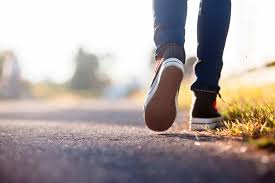
March 1st will mark the anniversary of a tragic event in the community of North Peoria. A beautiful young high school student who loved the outdoors did what the majority of her peers in her neighborhood avoided; she walked to her high school. Abigail Melisko was 16 years old and was described by her peers as a popular student who was active in track and basketball. I remember that morning of March 1st, 2016, hearing the sirens of the police cars and ambulances and eventually the sound of the Air Evac helicopter. Abigail was struck by a car at the intersection of 87th Avenue and Lake Pleasant Parkway while in a crosswalk with a walk signal. She was airlifted to a local hospital with life-threatening injuries and was in a coma for nearly a month and eventually died shortly after her family removed her from life support.


Injuries and deaths of pedestrians and bikers have created an understandable avoidance to engage in the healthy lifestyle habits of walking and biking. Parents are left to protect their children from the immediate harms of motor vehicle injury or assault by chauffeuring them to their destinations or when old enough, equipping them as soon as possible to drive themselves.
In 1969, the National Household Travel Survey reported that approximately 41% of school-age children in grades K-8 lived within one mile of school and 89% of these children walked or bicycled to school (PIBC, 2013). A more recent statistic shows a dramatic decline with an estimated 44 percent of children living within one mile of school and only 17% of these children either walking or biking to school (National Center, 2010).
There are many factors that have contributed to the decline of walking and biking. The U.S. Centers for Disease Control and Prevention conducted a survey to find the most common barriers that parents reported :
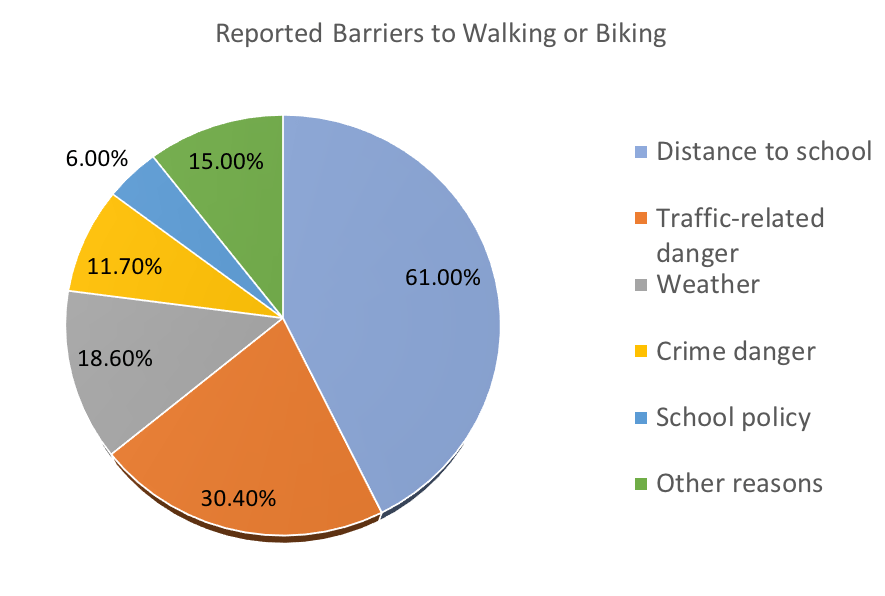
Although these safety and convenience issues highlighted here are related to children getting to school, such concerns of distance, traffic safety and crime danger are shared by all community members. These issues are demonstrative of urban environments that are poorly designed for physical activity.
Regular physical activity can reduce the burden of chronic diseases such as heart disease, diabetes, and some cancers, as well as prevent early death (CDC, 2017). Abigail Melisko was on her way to a long and healthy life. Unfortunately, hers was cut short not by a disregard of engaging in healthy lifestyle behaviors, but rather due to a poorly designed urban community that failed to ensure a safe walking route. Health care providers spend a great deal of time promoting physical activity in the confines of the patient exam room. It is also imperative for providers to sit at the table of urban planning and advocate for our patients so they may live in built environments that are free of barriers to this vital aspect of health maintenance.
References
Center for Disease Control and Prevention. (2005). Barriers to children walking to or from school — united states, 2004. Retrieved from https://www.cdc.gov/mmwr/preview/mmwrhtml/mm5438a2.htm
Center for Disease Control and Prevention. (2017). Step it up! the surgeon general’s call to action to promote walking and walkable communities. Retrieved from https://www.cdc.gov/physicalactivity/walking/call-to-action/index.htm
National Center for Safe Routes to School. (2010). Safe routes to school travel data: A look at baseline results from parent surveys and student travel tallies. Retrieved from http://archive.saferoutesinfo.org//sites/default/files/SRTS_baseline_data_report.pdf
Pedestrian and Bicycle Information Center. (2013). The decline of walking and bicycling. Retrieved from http://guide.saferoutesinfo.org/introduction/the_decline_of_walking_and_bicycling.cfm
Tudor-Locke, C., Ainsworth, B., & Popkin, B. (2001). Active commuting to school. Sports Medicine, 31(5), 309-313. doi:10.2165/00007256-200131050-00001

 One Health
Debra,
So unfortunate that such a terrible tragedy had to be endured to bring awareness to such an important issue. You captured our responsibility so well, by recognizing that awareness, and efforts for addressing the matters that affect our patients health, ought to go behind the exam room, to be acting in our full capacity.
I am excited to follow along with your efforts this semester. If you have no already done so, you should look into the Blue Zone project : https://bluezones.com/services/blue-zones-project/#section-6. In 2004, the National Geographic partnered with American researcher/author Dan Buettner, to study the healthiest, long lived places in the world. The places selected to study demonstrated the highest percentages of those who reached 100, and also demonstrated the lowest incidence of chronic disease. There were five “blue zones” studied, all varied in geographical location, and cultural practices, however, 9 themes were strongly uniform each place. The top identified habit of these long-lived healthy communities was “moving naturally”. The Blue Zone Project came about following the 2004 researach findings, in efforts to develop community, and policy efforts to adopt these 9 principles into American’s every day life. I think that the resources found here may pique your interest and help inspire actionable solutions and suggestions for the Peoria Community!.
Buettner, d. (2014). Reverse engineering longevity. retrieved from:https://bluezones.com/2016/11/power-9/
Carter, E. D. (2015). Making the Blue Zones: Neoliberalism and nudges in public health promotion. Social Science & Medicine, 133, 374-382.
LikeLike
I just recently became familiar with Dan Buettner and his work while researching for my blog and was very excited to hear about the Blue Zone project. It is encouraging to know that there is a strong movement to improve population health. I plan to discuss his work in my next blog as it relates well to the issues I have brought up. As you pointed out, encouraging the habit of “moving naturally” is a vital part of any sustainable approach to promoting longevity with functional health intact. With this in mind, health minded urban planning is so important. Looking forward to hearing further thoughts and insight!
LikeLiked by 2 people
This is an interesting topic. I never thought of urban planning in relation to healthcare. Literature says that urban planning is now considered as a comprehensive strategy to prevent healthcare problems. It is really important that people should be able to walk safely to work, school, shopping or for fun. It is very unfortunate that approximately 70,000 pedestrians were injured on roadways in 2004, and many of these were severe injuries National Highway (Traffic Safety Administration, 2004).
The United States Department of Transportation (USDOT) issued a Policy Statement on Bicycle and Pedestrian Accommodation Regulations and Recommendations in 2010. Arizona Department of Transportation (ADOT), MGT 02-1 Bicycle Policy promotes bicycling and walking even alongside state highways. The vision of the ADOT regarding bicycling and walking is “Arizona will become a state where people of all ages and abilities can conveniently, comfortably, and safely walk or bicycle to destinations as part of their everyday life. The quality of life and health of Arizona residents will be improved as more people choose to walk or bike” (Arizona Department of Transportation, 2013).
Reference
American Association of State Highway and Transportation Officials, Guide for the planning, design, and operation of pedestrian facilities, Washington, D.C., 2004.
Arizona Department of Transportation. (2013). ADOT statewide bicycle and pedestrian plan update. Retrieved from https://apps.azdot.gov/files/ADOTLibrary/Multimodal_Planning_Division/Bicycle-Pedestrian/Bicycle_Pedestrian_Plan_Update-Final_Report-1306.pdf
LikeLike
Thank you for sharing the ADOT bicycle and pedestrian plan, this is a very thorough resource regarding our state’s approach for this health policy issue!
LikeLike